Achilles Tendinopathy Treatment in London — Shockwave Therapy

Clinically validated shockwave therapy for insertional and mid-portion Achilles tendinopathy. Non-invasive, no surgery.

Effective for chronic cases that have not responded to rest, physiotherapy, or eccentric loading alone.

Book a Free Consultation Call: 0203 004 0564
Clinically Proven Multiple RCTs published
Both Types Insertional & mid-portion
GMC Registered Dr Kishore Bahl — Physician
3–6 Sessions Typical treatment course

Why Achilles Tendinopathy Is Notoriously Hard to Resolve

Achilles tendinopathy is one of the most common overuse injuries in both recreational and competitive athletes — but it is by no means restricted to people who run or play sport. Degenerative changes in the Achilles tendon can develop in anyone, and the resulting pain, stiffness, and reduced function can significantly limit daily activities for months or years.

There are two primary presentations. Mid-portion Achilles tendinopathy affects the tendon itself, typically 2–7cm above the heel bone, presenting as a fusiform swelling with localised tenderness. Insertional Achilles tendinopathy affects the point where the tendon meets the calcaneus (heel bone), often with associated calcification or bony prominence, and responds differently to rehabilitation protocols.

The challenge with both presentations is that tendon tissue has a relatively poor blood supply, making self-repair slow and unreliable. Eccentric loading exercises — the standard first-line treatment — help a significant proportion of mid-portion cases but have a much more limited evidence base for insertional tendinopathy. Cortisone injections provide temporary relief at the cost of weakening tendon tissue, increasing re-injury risk. Surgery carries meaningful downtime and is not without complication.

Shockwave therapy addresses this limitation directly. By delivering acoustic energy to the tendon, it stimulates the biological repair mechanisms that the tendon's limited vascularity otherwise restricts.

How Shockwave Therapy Treats Achilles Tendinopathy

The Mechanism

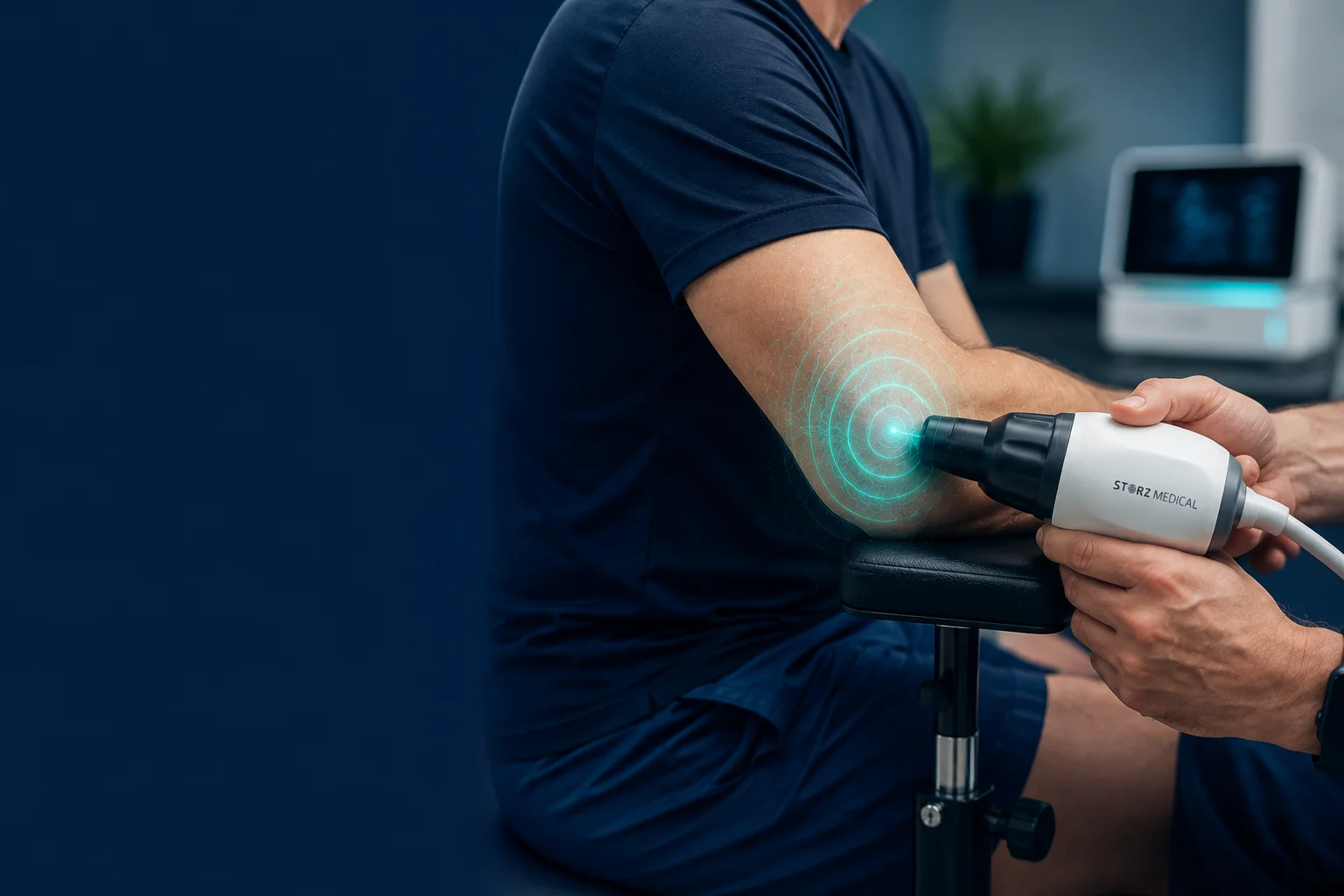
Extracorporeal shockwave therapy (ESWT) delivers focused acoustic pulses through the skin to the affected region of the Achilles tendon. At the cellular level, these pulses:

The combination of structural improvement and pain modulation makes ESWT effective not just as a pain suppressant but as a genuine treatment that promotes tendon healing. This is why clinical improvements are sustained at 12-month follow-up in published trials.

For insertional Achilles tendinopathy, shockwave therapy has a stronger evidence base than eccentric loading exercises — which can actually aggravate insertional presentations. This is a clinically important distinction that is often missed when patients receive generic Achilles rehabilitation advice.

No Surgery

Non-invasive

No Steroids

Preserves tendon strength

20 Minutes

Per session

No Downtime

Continue light activity

What to Expect During a Session

You will be positioned comfortably with the affected leg accessible. Ultrasound gel is applied to the tendon area and the shockwave applicator is placed on the skin. You will feel rapid pulses — most patients describe a tapping or vibration sensation. Sessions last 15–20 minutes.

No anaesthetic is required. Mild local soreness for 24–48 hours following each session is normal. We advise avoiding high-impact Achilles loading (running, jumping) for 48 hours after each treatment. Low-impact activity — cycling, swimming, walking — is generally fine throughout the course.

What Does the Research Show?

Multiple randomised controlled trials and systematic reviews support the use of ESWT for Achilles tendinopathy. A Cochrane-level systematic review comparing ESWT with other interventions found it significantly superior to eccentric loading for insertional Achilles tendinopathy, and comparable or superior for mid-portion cases when combined with a loading programme.

Both

Insertional & mid-portion cases treated effectively

6–12 wk

Typical recovery timeline post-treatment

12 mo+

Sustained improvement in published follow-up

For insertional Achilles tendinopathy, evidence from a 2012 RCT in the Journal of Orthopaedic & Sports Physical Therapy showed ESWT achieved significantly greater pain reduction and return-to-sport rates than eccentric loading alone at 4-month follow-up. The advantage was particularly pronounced in patients with radiological evidence of calcification at the tendon insertion.

For mid-portion Achilles tendinopathy, ESWT combined with a heavy slow resistance programme has been shown to be the most effective non-surgical intervention available, with outcomes comparable to surgical debridement in some trials — without the associated risks and recovery time.

Dr Bahl assesses each patient individually to determine the appropriate protocol for their specific presentation. Treatment approach differs between insertional and mid-portion cases.

Is Shockwave Therapy Right for Your Achilles Problem?

Shockwave therapy works well if you:

Have had Achilles pain for 6 weeks or more
Have insertional or mid-portion Achilles tendinopathy (confirmed or suspected)
Have tried eccentric loading with limited improvement (especially for insertional)
Are a runner or active person wanting to return to sport
Have calcification at the tendon insertion visible on imaging
Want to avoid surgery or cortisone injections

Consult first if you have:

An acute tendon rupture (requires surgical evaluation)
Active tendon infection or inflammatory arthritis affecting the tendon
A clotting disorder or are on anticoagulant medication
Symptoms of less than 6 weeks — standard physiotherapy should be tried first

If you are unsure about your diagnosis, we can advise at your free consultation. Existing scans are helpful but not required.

Your Treatment Journey

1
Free Consultation

Dr Bahl reviews your symptoms, duration, activity level, and any previous imaging. He distinguishes between insertional and mid-portion presentations to plan the correct protocol.

2
Personalised Treatment Plan

A course of 3–6 weekly sessions is designed for your specific presentation. Insertional and mid-portion cases use different treatment parameters. Costs are agreed before starting.

3
Weekly Sessions

15–20 minutes per session. Continue light activity throughout. Avoid high-impact Achilles loading for 48 hours after each session. Mild soreness is normal.

4
Rehabilitation & Return to Sport

We provide guidance on graduated loading and return-to-running timelines. Most runners can resume training within 6–12 weeks of completing treatment.

Why Choose Shockwave ReVibe?

🎯

Correct Protocol for Your Presentation

Insertional and mid-portion Achilles tendinopathy require different treatment parameters. We distinguish between them — and adjust accordingly, rather than applying a generic protocol.

🎓

GMC-Registered Physician

All treatment by Dr Kishore Bahl, GMC-registered Medical Doctor (GMC No. 6070860) with 30 years' clinical experience. Doctor-led, not technician-led.

📋

Clinical-Grade Equipment

CE-marked shockwave devices used throughout — the same category of equipment as NHS and hospital-based centres. Evidence-based energy settings for tendinopathy treatment.

🔐

Central London Location

22 Notting Hill Gate, London W11 3JE — directly accessible from Notting Hill Gate tube station (Central and Circle lines). Easy access from Kensington, Chelsea, Bayswater, and beyond.

👥

Honest, Evidence-Based Advice

If shockwave therapy is not the most appropriate intervention for your Achilles problem, we will tell you — and recommend a better option. We don't recommend treatment that won't benefit you.

💲

Transparent Pricing

Pricing confirmed at your free consultation, before any commitment. No hidden costs. No pressure to book additional sessions beyond what is clinically appropriate.

Achilles Tendinopathy Shockwave Therapy — FAQs

Can shockwave therapy treat Achilles tendinopathy?
Yes. Shockwave therapy is a clinically validated treatment for both insertional and mid-portion Achilles tendinopathy, particularly for cases that have not responded to eccentric loading exercises or physiotherapy alone. Multiple randomised controlled trials confirm its efficacy, with sustained improvement reported at 12-month follow-up.
What is the difference between insertional and mid-portion Achilles tendinopathy?
Insertional tendinopathy affects the point where the Achilles tendon attaches to the heel bone (calcaneus) — often accompanied by a bony prominence or calcification. Mid-portion tendinopathy affects the tendon body itself, approximately 2–7cm above the heel. Both respond to shockwave therapy, but the treatment parameters differ. Eccentric loading — often prescribed as standard — can actually worsen insertional tendinopathy, which is why correct diagnosis matters.
How many sessions do I need?
Most patients require 3–6 sessions spaced one week apart. The exact number depends on which type of tendinopathy you have, how long you have had it, and symptom severity. We advise the appropriate course at your free consultation, and costs are confirmed before any sessions begin.
When can I run again after shockwave therapy for Achilles?
Most patients can maintain some level of activity throughout treatment. High-impact loading (running, jumping) should be avoided for 48 hours after each session. Most runners see meaningful improvement within 6–12 weeks of completing a course and can return to training on a graduated basis. We provide specific return-to-sport guidance based on your individual progression.
Should I stop doing eccentric calf raises if I have insertional Achilles tendinopathy?
For insertional Achilles tendinopathy, eccentric loading through a full range — particularly stretching the tendon at the insertion — can worsen symptoms. This is a well-documented phenomenon. We will discuss appropriate loading during your consultation. Heavy slow resistance training in a pain-free range is generally preferable to aggressive eccentric protocols for insertional presentations.
Is shockwave therapy painful for Achilles tendinopathy?
Sessions are generally well tolerated. You will feel rapid pulses — a tapping or mild vibration over the tendon. Some patients experience temporary soreness at the treatment site for 24–48 hours afterwards, which is a normal and expected part of the tissue healing response. No anaesthetic is required and you can resume normal activity the same day.

Treatment by Dr Kishore Bahl — GMC-Registered Physician

All treatment at Shockwave ReVibe is provided by Dr Kishore Bahl, a GMC-registered Medical Doctor with over 30 years of clinical experience in NHS and private practice. Dr Bahl holds BSc and MBBS degrees and is registered with the General Medical Council (GMC Registration No. 6070860).

Dr Bahl applies evidence-based shockwave protocols for musculoskeletal conditions, working exclusively with clinical-grade CE-marked equipment. He assesses every patient personally, distinguishes between insertional and mid-portion presentations, and designs the treatment approach accordingly.

GMC Registered
BSc, MBBS
30 Yrs Experience
ISMST Certified

Get Your Achilles Properly Assessed

Book a free consultation at Shockwave ReVibe. Dr Bahl will distinguish between insertional and mid-portion tendinopathy, confirm whether shockwave therapy is the right option, and explain the expected outcomes honestly. No obligation to proceed.

Find Us on Google

Share your experience — your review helps others discover our clinic.

View on Google Maps ★ Leave a Review